
This analysis approach uses a space-for-time substitution to predict expected large flood magnitudes given the streamgage record in nearby watersheds, in zones of similar flood response. Regressions of record peak discharges for streamgages across each zone define the expected flood potential, with high explained variance (average R2 = 0.93). The 90% prediction limit defines the maximum likely flood potential, with discharges above this being extreme and departure indicating the degree of extremity.
From these zonal regressions, indices were developed to test for trends in the magnitudes, frequency, and flashiness of large floods, and to facilitate the comparison of flooding characteristics across regions and continents to help understand and communicate about flood hazards and how they vary.
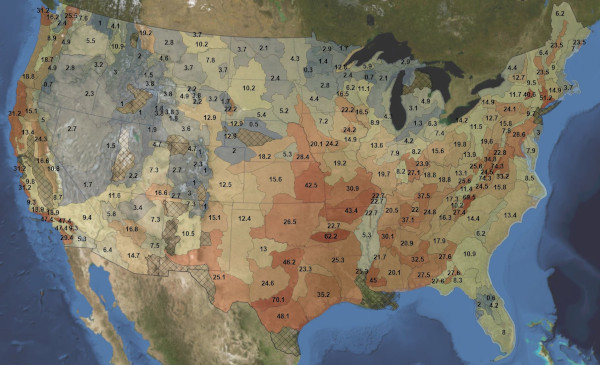
The Flood Potential Portal (FPP) is a decision support system developed, in part, to serve the results of these analyses through a map-based interface. This tool was developed as a collaboration between Colorado State University One Water Solutions Institute (OWSI) and the U.S. Forest Service National Stream and Aquatic Ecology Center (NSAEC). For continental through catchment scales, the FPP provides practitioners enhanced understanding of flood hazards, highlighting flood variability over space and time, and tools for quantifying flood magnitudes for user-selected watersheds. The FPP provides a one-stop shop for flood prediction, including a module for computing tools for flood potential, index flood frequency, and regional regression flood frequency (StreamStats) discharge predictions for quantifying design flood discharges, as well as a module for computing streamgage flood-frequency analyses using the Bulletin 17B and Bulletin 17C methods.
The flood potential methodology was developed to be used in companion with traditional flood-frequency methods, and assists practitioners with answering such questions as:
- What large flood magnitudes can be expected at a given ungaged location, for designing infrastructure and managing floodplains?
- Are the results of regional flood frequency regression equations (StreamStats) appropriate?
- Are flood frequency analyses at streamgages providing reasonable results, or are results biased due to the presence or absence of large floods in the records, or by the nature of the Pearson distribution within a setting where bimodal (or multimodal) floods occur due to mixed populations?
- What areas are inherently prone to higher or smaller flood potential (experience larger or smaller floods)? This helps make more informed decisions regarding: erosion hazards of stream corridors; higher costs for stream valley infrastructure maintenance or replacement; inherent risks of stream restoration; risks of wildfire-induced flooding or debris flows on communities
- Is a specific flood extreme, or rather a typical large flood?
- Compared to other floods in the area, how extreme is a flood?
- Are floods increasing in magnitudes, frequency, or flashiness over time?
Primary References
- Flood Severity Scale and Flood Status Portal: Tools for Response and Recovery (River Research and Applications, Yochum et al., In Review)
- Bias in peak flood discharges: Are our bridges and culverts undersized? (River Research and Applications; Yochum and Wible, 2026)
- Flood Potential Portal: A web tool for understanding flood variability and predicting peak discharges (River Research and Applications; Yochum et al., 2024)
- Flood Potential Portal User Manual (Yochum et al., 20**)
- Flood Variability in the Western United States: Overview and Examples (SEDHYD-2023 Proceedings; Yochum and Levinson, 2023)
- Flood Potential in the Southern Rocky Mountains Region and Beyond (SEDHYD-2019 Proceedings; Yochum, 2019)
- Methods for Assessing Expected Flood Potential and Variability: Southern Rocky Mountains Region (Water Resources Research; Yochum et al. 2019)
Supporting Data and GIS Files
- Flood Potential Zones (shapefile; v20, 2025-10)
- Extreme Watersheds (shapefile, boundaries for watersheds that have experienced extreme floods; v9, 2025-9)
- Streamgages and Watersheds, West (shapefile; v7, 2025-9)
- Streamgages and Watersheds, East (shapefile; v5, 2025-9)
- Supporting Data: Bias Peak Q (supporting tabular and GIS data for Bias in peak flood discharges: Are our bridges and culverts undersized?)
- Supporting Data: Testing Flood Severity Scale (supporting tabular data for Flood Severity Scale and Flood Status Portal: Tools for Response and Recovery)